A throwback to the 100th episode of Eugénie Krüger’s Homeopathy Hangout Podcast. This milestone episode first aired in August of 2021! Eugénie is an Australian homeopath, podcaster and mother. You can listen to literally hundreds of her podcasts, hanging out with Eugenie as she chats with homeopaths and homeoholics from every other country in the world!!!
In this episode, I chat with Eugénie about a few of the brilliant experiences I have had with homeopathy this lifetime. Some of these experiences changed my thinking about homeopathy from an mildly interesting alternative system of healing to one that I became passionate about. I believe that homeopathy is medicine for the people and home users can get great results once they know how. Eugenie shares some of the lessons she has learned over her decades using homeopathy as a mother and a practitioner.
QUICK SUMMARY: This is a reflective interview in which Miranda Castro recounts her personal and professional journey with homeopathy, highlighting both skepticism and conviction shaped by experience. Castro describes early exposure to homeopathy through a naturopathic family doctor and her own experimentation with remedy kits as a teenager. Initially, she saw it as useful mainly for minor ailments. Her confidence was shaken further after several ineffective treatments from different practitioners, leading her to dismiss homeopathy as unreliable for serious conditions. A turning point came when her son suffered from a persistent illness that conventional and alternative treatments failed to resolve. Through a referral, she eventually consulted a skilled classical homeopath who considered the “whole picture” of the patient rather than isolated symptoms. The correct remedy produced rapid and lasting improvement, transforming Castro’s perspective and inspiring her to formally study homeopathy. She emphasizes that effective homeopathy depends on identifying a precise remedy tailored to the individual, not guesswork based on symptoms alone. Castro advocates teaching laypeople simplified methods to use homeopathy safely, aligning with her broader mission of empowering self-care. The article also includes case stories—such as treating a severe burn and chronic shoulder pain—that illustrate both successes and challenges, reinforcing her view that deep knowledge and careful analysis are essential. Overall, the interview portrays homeopathy as a nuanced practice requiring skill, persistence, and a holistic understanding of the patient.: A Lifetime of HomeopathyYou can listen to the podcast or read the transcript below!
E: Hello homies and a very warm welcome to Homeopathy Hangout. Today we get to hang out with homeopathic goddess, Miranda Castro. Welcome to the show. It’s so lovely to have you on today, Miranda. I have nicknamed you homeopathic goddess because of the decades of incredible work that you have done to bring homeopathy to the homes, to the mothers, in their hands, make it usable, make it relatable. So that’s a title very well deserved.Welcome to the show.
M: Thank you, Eugenie. It’s great to be here. I accept most humbly, the honour of being called homeopathic goddess!
E: So for those that don’t know you, and I can’t imagine there’s anyone in the world who doesn’t, can you tell (our listeners) a little bit about your homeopathic journey, how you were introduced to homeopathy and how it’s evolved from there?
M: You know, it’s been a part of my whole life. Our family doctor growing up was a naturopath and he used homeopathy and herbs and tissue salts when my brother and I were sick. I hated the herbal tinctures. They were always truly vile, but those cell salts and the little homeopathic pills, they were brilliant. He was an osteopath too, so he did adjustments and he was a kind man. I did need the doctors from time to time, but hardly at all.
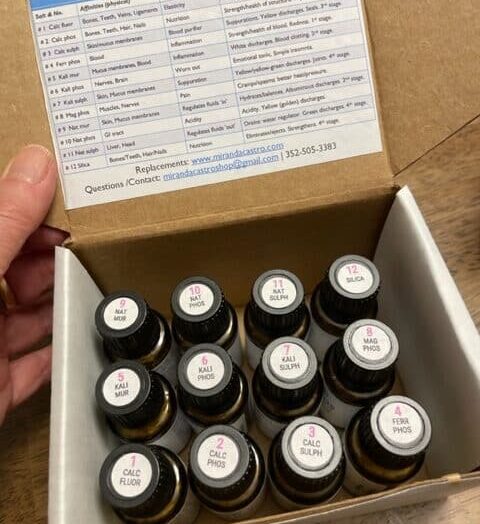
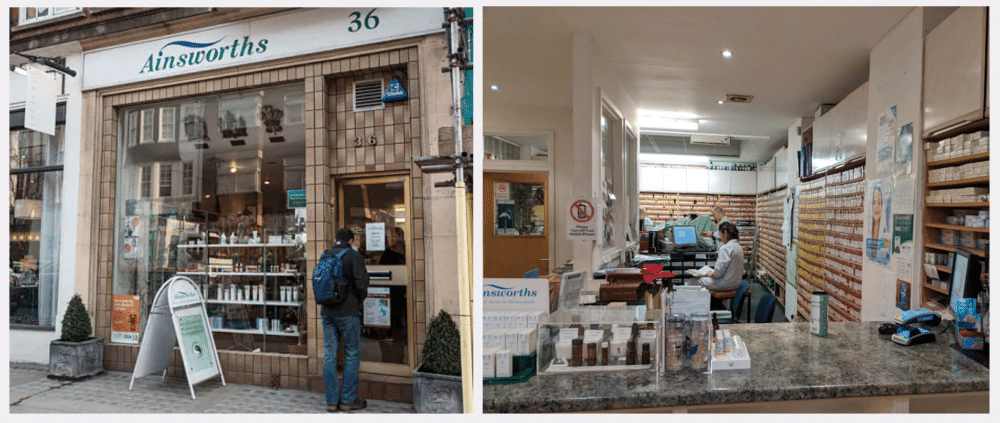
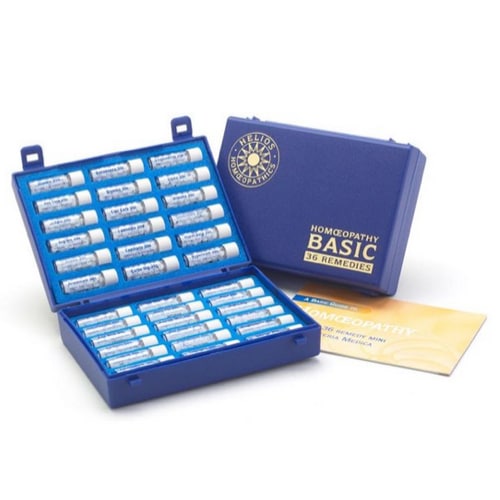
M: When I left home at 16, I went to the homeopathic pharmacy and I bought a 36 remedy kit and all 12 cell salts in one little box. And I got a couple of books. They were slim books. They weren’t anything very fancy. I don’t think I had much of a choice, but I got the books that were available. So Gibson’s First Aid in Accidents and Ailments and the Cell Salt Handbook. And that’s all I used for, I don’t know, 10 years more, 12 years at least. I lived in the mountains in France for a few years doing the hippie thing and none of us needed the doctor. I would just, if I got cystitis or a sore throat or a cough, whatever it was, I just would get all out my kits.
E: Have you still got that kit? Because I listened to an interview you did many years ago and you said, I still have the kit. And I was like, oh, I wonder if you still have it.
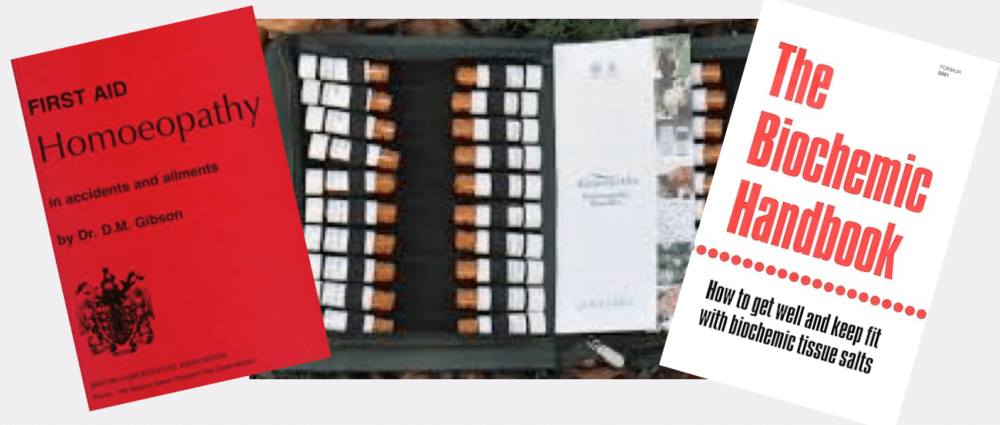
M: I had it until last year when it finally, because it was in a cardboard box, it finally fell apart. In Florida, it’s so humid here, the mold finally got to it.
E: You’ve been all over the world because you started out in the UK, hey?
M: Yeah, I’m British and a Londoner. How I came to homeopathy is a different story. I mean, I have told it before and I’ve written about it so I apologize to those of you who have heard it already. Daniel, my son, was born when I was 28.
M: And when he was about two or a bit younger, he got whooping cough very badly. It lasted for months, like it can do, months and months, six months altogether. And the first three months were pretty bad. At night, he would wake coughing and vomiting many times during the night. I gave him good remedies.
M: I gave him Drosera, which is the number one remedy for whooping cough. And then when it stopped helping, I called the pharmacy. In England, the homeopathic pharmacist will advise you. They suggested I give him Pertussin 30C.
M: This helped, but it didn’t hold. So, then I went on this long trek from, oh my gosh, from one alternative healthcare practitioner to the next. I went to four homeopaths, two of whom were doctors who both gave routine prescriptions.
M: The first doctor was very expensive, private, Harley Street. He actually gave a prescription with four remedies. And he said, give one for three days. If it doesn’t work, go to the next and if that doesn’t help the next and so on. Over 12 days, we tried each one. None of them helped.
M: One of the other practitioners was a Rudolf Steiner homeopath, an anthroposophical practitioner. He spent the whole consultation flicking through a book to and fro, to and fro. I didn’t know what that meant, but I was, you know, just going with the flow like you do in a doctor’s office. And he gave a complicated prescription, a herbal tea, drops, a remedy, well, several remedies, alternating at different times of day.
M: They didn’t do a thing. And I came to the conclusion he didn’t know much, that he was still studying and that’s why he had to keep looking things up in his book! And we’re laughing because, you know, in every consultation I may flick through a book to check something up. In our repertoires. From this experience with Daniel I learnt to tell my patients what I’m doing so they are not sitting there thinking, what on earth is this about? You know, our experiences inform us, don’t they, to some extent. And the other, the final homeopath was a gentleman farmer. I lived in the country and I visited him in his kitchen. He used Boericke’s Materia Medica, and he said, you know homeopathy helps my animals. And my family and my friends, I’ll have a go. And so he had a go. And the remedy didn’t work.
M: I washed my hands of homeopathy. I said, this homeopathy, it’s good for not very serious acute illnesses. But once you’re really sick, it’s worthless. I gave up. I went to other healthcare practitioners, all kinds of interesting people. Some of them helped a little, one person helped a lot, but nothing held. His symptoms, the cough, kept returning.
M: Do you know what radionics is in Australia? This is distant healing. You send a practitioner a lock of hair or a drop of blood, some source material from the person who is to be treated. In England, the racehorses all get treated by radionics practitioners.
M: I found an experienced practitioner and I sent her a little lock of Daniel’s hair, and her treatments were astonishing. He would be well for a whole week at a time. And then, boom, he relapsed. So, finally, she tells me she checked out what he needs, and he needs homeopathy. And I just thought that was the funniest thing I’d heard. She asked me about my experiences. I went through it all, and she said, yeah, you haven’t seen a classical homeopath, have you?” I said “I don’t know.”
M: She had intuited that Daniel had a miasmatic block. She said, he’s got a miasm—an inherited weakness. Nothing you do will help until that’s removed. And the only thing that can remove it is a homeopath who knows what they’re doing and can work with inherited weaknesses. Okay, I’ll try it, I said, but only because she was very, very certain and very strong. She gave me a referral.
M: I called the practitioner. He prescribed Pertussin 200C. I didn’t know about going up in potency when the lower potencies stop working, but only if they work very well. Overnight, the vomiting stopped.
M: A week later, we went in for a full intake, a full, first consultation. And it was a very different experience. It wasn’t just, give me the symptoms. The homeopath looked at his whole picture. And he gave a deep acting remedy in high potency that addressed the ‘miasmatic block’. The cough disappeared overnight. And his general health and well-being improved.
E: That is a powerful message with some incredible lessons in there for our listeners as well. If you’ve gone to a couple of practitioners, don’t just give up, because when you do find that correct remedy, then it will really work on such a deep level. And how amazing for you, the universe was just pulling you back. You were destined to make this your life’s work.
M: I had trained as an acupuncturist at this point and during my pregnancy, I was completing my clinical training. I had a hard pregnancy and a hard birth. And after the birth, I couldn’t help either myself or Daniel with any of our problems with acupuncture, with any physical or emotional healing, nothing, nothing. And so I fell out with acupuncture.
M: It was partly the school I went to, but also every system of healing has its limitations. It’s good to know what they are. And I learned from this experience that I couldn’t help people to help themselves with acupuncture. Patients had to keep coming back to me for healing. So it didn’t really agree with my mission—to help people to help themselves. When I saw constitutional homeopathy work like a charm, like a miracle after so much hadn’t worked, I said, oh gosh, I want more of this. I was in homeopathy school within the month. And the rest is history.
M: I’ve been on a mission since then because I got it in a heartbeat that first aid prescribing brings people into homeopathy. But if you’re just looking at symptoms, if you just look at sore throat or cystitis or injury, whatever it is, and you pick a remedy, one of the top remedies, even if you cycle through the top four, six, whatever, it’s still hit and miss. You’re guessing.
M: Once I understood from my training how important the whole picture is, oh man, now I was on a mission. I said, I wonder if I can teach people, if I can just scale back what I do for the home prescriber and teach my patients how to help themselves with simple remedy pictures and a mini index of symptoms, a mini repertory. And I wrote that up and I taught it for years and it was really successful.
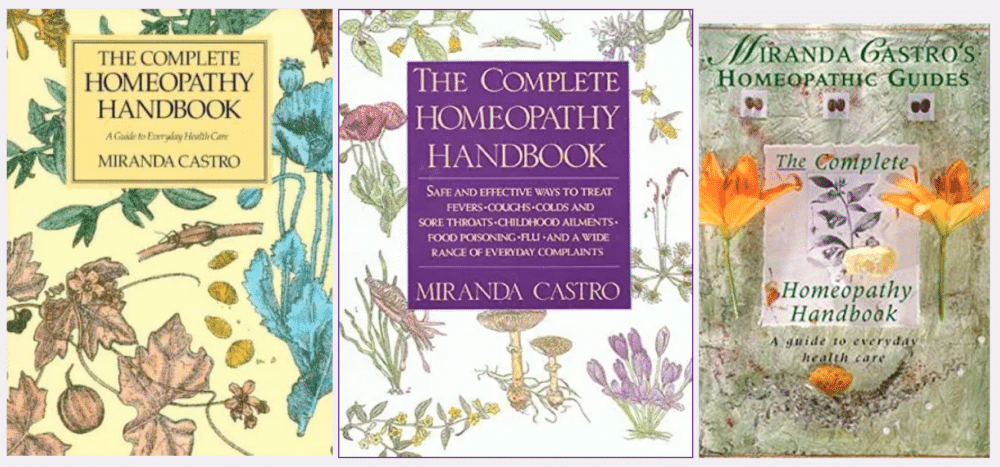
M: So I just got more and more ambitious. I said, okay, I’ll write the book. But that, that was hard. It was so much work. And it took me years to end up with a product that has now continuously been in print for like, I don’t know, 35 years or something.
E: And you’ve sold like a quarter million copies or something like that.
M: Half a million! It’s more like half a million now. According to the publishers it is a best-seller and a modern classic!
E: And I just want to say the name of the book for those listeners out there. It’s called The Complete Homeopathy Handbook. It is a nice chunky one with all the incredible information in there you could possibly want. Beautiful. I’ve got the one that’s got a different cover on it.
M: So it’s a book for home prescribers, a mini version of the books I use in my consulting room. You can’t look up a symptom and get a remedy. You have to work up the ‘case’. You have to figure out what are the general symptoms here? Is my kid more or less thirsty than usual? Are they sweating with the fever or not? What kind of pain is it? And what started before the pain? Was there a stressor, an injury or an upset at school or a death in the family? Something that set it off. And you build all that into a little picture, write it down and see which remedies are in each one of the symptoms. Or most of them.
M: And then you read the pictures, the picture of each of the remedies that are well-indicated. And nine times out of ten, you go, boom there it is! Calcarea carbonica. Amazing. That’s the one that ‘fits.’
M: People say to me “How did Miranda know that my kid craves eggs? It is amazing. Sometimes it feels like, you know, homeopathic magic. Like how does she i.e. her book know this weird thing that a little, you know, confirmatory symptom but also is something my child does.
M: But once you get a picture, then everything else tends to fall into place. And it’s just beautiful. It really is.
E: And you’ve managed to do something that very few homeopaths have done. This book is almost like a mainstream book because I checked and we can buy it over here in Dimmocks in Australia. So, you know, it’s like a very mainstream bookshop. And this book is so accessible. It’s so powerful. So well laid out.
E: I love that you have a little picture, a small picture of each remedy. It’s very helpful. You know, there are, there are so many homeopathy books out there, but not that many of them that are really user-friendly and yours is!
M: I had a goal. I had a goal to translate all the jargon, all the homeo-speak into ordinary English. But I had never written anything when I had the idea to write this book. Nothing. I had written nothing. So I got a lot of help. I got help from writers and I got an agent who got me a contract with a mainstream publisher who knew they had to help me write it.
E: Wow. Without a previous writing history, you managed to do that.
M: It couldn’t happen today. It just couldn’t happen. My first manuscript was ridiculous. It was long, half a million words long! My editor edited it 6 times. I rewrote it six times. That couldn’t happen today. So I am so grateful to all the people who helped me along the way. I mean, so grateful and I’m very proud of it.
M: It’s done a good job. It stood the test of time and actually it had an unintended consequence. I wanted to get the home user as passionate as me about classical homeopathy, understanding it, being willing to do a little bit of extra work because it can seem like a drag at the time that you’re doing it.
M: You want a quick fix. And then when you see that amazing result, when you have that experience, especially with a sick kid, you go, yeah, that was worth it…I could have cycled, taken way more time and cycled through way more remedies and not gotten this result.
M: So the unintended consequence is that people got such good results some of them decided to go to homeopathy school. Amazing. When I teach in colleges now, I ask who started out with my book. I learned to ask that question because people had been coming up to me excitedly at breaks to tell me they started out their homeopathic journey with my book …
E: Like me. Fangirls. Yeah, absolutely. I was telling you, I’m like the hugest fangirl.
M: And so, one time I was teaching at an Irish school and half the class were there because they’d started out with my book and it just was so inspirational to see such a beautiful thing. I mean, this is an elegant system of healing and it does not help all the time.
E: Nothing does, but it is just beautiful. So you must have a gazillion stories that you can share with us with all, with all of these years of experience behind you.
M: I brought two stories where well-indicated remedies didn’t work. One after another didn’t work. I went to New Zealand to teach at Susanna Shelton’s school.
E: Oh, she’s lovely. Yeah.
M: Yeah. You know, your podcasts are, are amazing. You didn’t know that, you know, that they are a literal treasure trove.
M: I’ve listened to loads of them and I feel this incredible connection to a worldwide web of homeopathic healers. I mean, honestly, we’re an amazing group of people and what you’re doing is connecting us all. And it is just a beautiful thing.
E: You are giving me all over body goosebumps, but thank you so much. And it’s, it’s a funny thing. Cause I feel like when us homeopaths chat with each other, there is this instant connection because I think we are such a passionate bunch because you know, we know we can help the world so much.
E: And so there is that instant connection, but Susanna is really special. She taught at the college where I trained in New Zealand. So yeah, she had already left by the time I was there, but now she’s back at that same college.
M: So I arrived in New Zealand after a 23 hour flight. Suzanna is hosting me in her house. My computer is a long dead so the first thing I do is plug it into wall using the adapter I brought with me. Because I’m teaching the next day. I guess there was something very wrong with the adapter. It literally blew up in my hand.
M: The whole room filled with black smoke smelling of burnt flesh and plastic and metal. I have had a lot of interesting accidents in my life. If it weren’t for homeopathy, I wouldn’t be here in the way I am. I mean, I wouldn’t be dead, but I might be sort of incapacitated in a wheelchair or something like that, you know, just crying into my soup.
M: So when I have an accident, I go into myself to gather my forces. I closed my hand. Tightly. I didn’t know how badly injured I was. I said “bathroom” and my shocked host guided me to it. I put my hand under cold running water and very slowly opened it. The whole palm of my hand and fingers were completely black. I waited for the pain, you know that will come, that you’re in shock at first. I could only feel some pain in one finger. So then I rubbed the soot a little bit and saw that I was mostly very lucky.
M: My skin was singe, and I had a hole in the underside of my middle finger, but it hadn’t cut through tendons or nerves. I could still move my finger. The rest of the hand wasn’t badly burnt or damaged. Suzanna’s doctor friend came around and cleaned everything and debrided the deep burn and dressed it. She was impressed at how bad and deep the hole was.
M: She told me not to take the bandage off for three, four, if possible five days. Here’s the problem, don’t say “don’t” to me. So then because it’s a third degree deep burn I took Causticum every five – seven minutes just like Dorothy Shepherd (Homeopathy for the First Aider) tells us to.
M: It had no effect whatsoever. It didn’t help not even one jot. And so I tried a couple of other remedies. I don’t remember which ones now but they didn’t help either. So now what do we do? Suzanna was the brilliant person in this situation. She said “Hang on a sec – this burn has clean edges. After her doctor friend cleaned it up the actual wound had clear edges and it looked like it had been punched out.” Hmm. So “punched out” that is a key note, punched out ulcers in particular, but also very severe burns. When you put those two together, you get one remedy and it’s Kali bichromicum.
E: Kali bich! It’s not a remedy I ever would have thought of for burns.
M: Me neither. But it’s, um, almost a specific for a very bad burn, for chemical and electrical burns, but also old burns that haven’t healed, that aren’t healing. It’s like a fourth degree burn.
E: Mental note to self, don’t say “don’t” to Miranda.
M: Anyway, within minutes of taking, I don’t even remember what potency, probably a 200C, but it could have been a 30C but of course it doesn’t matter. The right remedy will work in any potency. After just a few minutes the pain eased up and it started to feel so much better. So then I ripped off the bandages. This is about two hours after she put them on. Not the three to five days! And you could see it visibly healing. The next day I taught with a band aid on my finger. No pain.
M: This is where homeopathy fails, where you have to work hard and know lots. Your knowledge base has to be really wide in order to help people, more of the people, more of the time. And if you don’t know the remedy, it can be hard. So I injured my shoulder. I mean, it was bad. I fell onto my outstretched hand, my whole body, the weight of my whole body shunted back and caused a terrible inflammation, a bursitis. I didn’t know that, initially, and I know for people who’ve had a bursitis of the shoulder, it’s agony. I mean, literally so so painful. I tried many remedies, maybe a dozen, maybe 20 over the course of a couple of weeks. I took great remedies. My homeopathic practitioner worked really hard, worked up my symptoms, because it was a fairly straightforward injury.
M: At one point, I went and got a steroid shot. It was that painful. I couldn’t sleep. I hadn’t slept in weeks. I went to the ER and I said, I need an x-ray to make sure it isn’t broken. And then if it isn’t broken, I want a steroid shot. So people will be shocked to hear this, I think, but I hope not so much because that’s what those medicines are there for. For emergencies like this. And also, you know, sleep is so important and so healing in itself. And if you’re not able to sleep because of the pain it’s bad. I was really desperate and desperate measures need desperate solutions and steroids are a miracle. Well, when the pain started to return a few months later, I knew I was on a hiding to nothing, as we say, do you say that?
E: No, I haven’t heard that one.
M: It means, I don’t know where it comes from, but it means that you’re going nowhere fast, basically. It’s going to be diminishing returns over time and then the side effects will kick in. It’s no good. I had terrible, sharp, stitching pains, worse for the slightest movement. Breathing was agony because the actual effort of taking a breath made the shoulder move and the tiniest bit of movement hurt something terrible. Heat helped. Those were the only symptoms I had. So it was worse for the slightest movement, better for heat, but using those two symptoms didn’t get us a remedy that helped me.
M: At one o’clock one night, when the pain really started ramping up and I knew I wasn’t going to be able to sleep, I said, okay, homeopathy, prove yourself. And I went to my desk and I vowed to stay there until I found a remedy. And I took these two symptoms and I made them into bigger, more general symptoms. So pain, worse for movement and pain, better for heat. I had hundreds of remedies. I went through them all in Allen’s Materia Medica, the big encyclopedia of remedies. I went through every single one alphabetically and it took me five hours because it was an R, a remedy that started with R. The one that I needed. From A through R I probably read 150 remedies in that time, really carefully, every remedy.
M: The remedy was Ranunculus bulbosus. Buttercup. This remedy has severe, terrible stitching pains, exhorting people cry from the pain. Worse for the slightest movement, but you won’t see this remedy listed in that rubric in the repertory. People who need it have pains that are worse for movement and better for heat. I had inherited a cabinet of remedies from a homeopath that had retired. And luckily there was an old bottle about 50 years old, a 3X.
E: Oh really, just a 3X?
M: The pills were brown from age. The saccharum lactose had degraded over time. I took a dose and immediately the pain started to ease up. I succussed it up to a 6X and it got even better. Over the next two years, each time the pain returned, I would take either the same potency or a slightly higher one—a 6C, then 9C then 12C and so on—just a few doses each time until I got to a 200C. After about two years, the pain didn’t return so often and only after I did something foolish that involved lifting a heavy item. And I haven’t had the pain since then.
E: So Miranda, I have a question for you. When you took that Ranunculus 3X, did you think it would work being that low? How did you know? Because I was saying to one of my staff just this morning that we, I think we homeopaths are the biggest skeptics because I’ve this however many episodes I do, when I do these 7am recordings with my guests in America, my throat takes a few hours in the morning to really get going. But this morning I took the Narayani Throat Chakra Remedy and I actually forgot that I’d taken it. At one stage, 10 minutes later, it sounds funny that I forgot but I was kind of busy and I just took it and I just, you know, did some other things. And then I was like, my throat is so much better. That, that thing that was stuck in there is gone. I’m like, how is this working? How could it work that fast? And it’s not supposed to work. How is it working? So, you know, we homeopaths are not like blind believers. We are skeptics ourselves. And still when these remedies work, they blow us away. Yeah, we should be skeptics. Cause I mean, a 3X ranunculus, it just goes against everything that we’re taught. It shouldn’t work. It does?
M: It doesn’t go against everything I’ve been taught! What I know is that the right remedy will work in any potency.
M: I have tested this myself because people say homeopathy is safe and it can do no harm, right? I do not say that. I think it makes us sound a little bit childlike, you know, as a profession, because anything that can effect such amazing healing responses is capable of harm. It has to be. It must be able to. Logically. The question is how. Of course we’re not killing people. It’s not that powerful and they are not toxic. But we test them on healthy people to see what symptoms they can elicit. And so, if you are a home prescriber and you overdo a remedy, it will elicit symptoms you might not have had before. Well, those symptoms will go away if you stop taking it, but they are experienced by people as side effects and in fact they are a kind of side effect.
M: They’re just a different interpretation of it. I always advise caution, especially with a remedy that doesn’t work. Don’t keep taking it. And if it does work, don’t keep taking it. You know, this is what’s so beautiful about homeopathy. It stimulates your body to heal itself. And then after that you can get on with your life.
E: You don’t need to think about it. As you just mentioned about side effects, it just suddenly popped up in my mind that we don’t actually have anything such as a side effect in homeopathy because a side effect is if you get an effect that’s different to what you expect from the remedy. But the reality is the remedies can produce so many different symptoms in, you know, in different people sort of.
E: So I don’t know if it’s a side effect, I think another thing, this is sorry, just a side topic is I think we need to rethink the words that we use in homeopathy. And my husband keeps telling me, you need to stop calling it homeopathy. You need to like globally as homeopaths need to start calling it nanomedicine or, or, you know, just like some of the wording that we use.
M: I agree. Yeah. Because people, the most common way people say it to me, you know, I’ll say, you know, I’m a homeopath and I say, Oh yes, I tried that. It didn’t work. And then they’ll say, why do you say home-opathy? Homeopathy. I mean, it is a mouthful and it’s not familiar to people.
M: The one thing I regret in my book is calling the index of symptoms a repertory and putting a repertorization chart in there. I just, that’s a mouthful. I’m sorry. I didn’t translate that.
E: But I think that’s also why your, your book is so effective is that actually apart from the repertory thing, it’s used in language that we, that normal people can understand. And that’s why when I do my homeopathy intro courses, all of the language that we get trained, I just convert that into language that is actually usable because we can use all these fancy terms that we use in homeopathy and make us sound really smart.
E: But if it’s not usable, user-friendly, actionable, something that the general public resonate with, they’re not going to use it. And that’s why also I hope that we stop putting the strangeness of homeopathy to the side and just make it usable and actionable. And I think that’s, what’s going to ensure the longevity of it, of it, because if homeopathy is strange, people are not going to resonate with it. So yeah. I do also, I like what your husband said.
E: Oh, he’ll be very happy to hear that.
M: And I also, I worry about us using the word cure. I feel that, um, you, you know, we, we’re overstating our abilities. We can help people. Um, and I see myself as a homeopathic healer. I can offer healing to everybody, but cure is a high, it’s a tall order. And we’ve sort of made, set the goal posts, if you like, too high through all, through only publishing our cured cases with remedies. So we made people, um, I don’t know. Have unrealistic expectations. Totally. So I would love to see the word healing used, you know, where, um, and I see us an energy healers. You know, this is energy medicine in a bottle. That’s it.
E: That’s how I look on it. I mean, no, no, no, we’ve got that. Yeah, absolutely. I think there’s more of that going to start coming out. It’s going to be very interesting, especially with, you know, the Homeopathic Research Institute and the things that they coming up with. I really feel in the next decade or so, we’re going to have a much better explanation for how homeopathy works. And when we do, that’s really going to be a clincher. I think for a lot of people who. Yeah.
M: I just choose not to wait that long to use something that’s incredibly effective. Why would you want to do that? If it works, then use it. No, it’s about how we talk about it and how it spreads. I think using it is brilliant and teaching about it. We have to, that’s, we’re on a mission and it heals from the inside out. That’s the other beautiful thing about it.
E: Like I said, super elegant. Yeah. And something that I always like to attach on there, I think the listeners are going to be sick of me saying it, but it’s so sustainable.
M: And then this day and age where it’s all about sustainability, homeopathy really is the medicine for that, for the future. It’s affordable and sustainable. I mean, my, yeah, my remedies that I carried around for 40, 50 years, they carried on working.
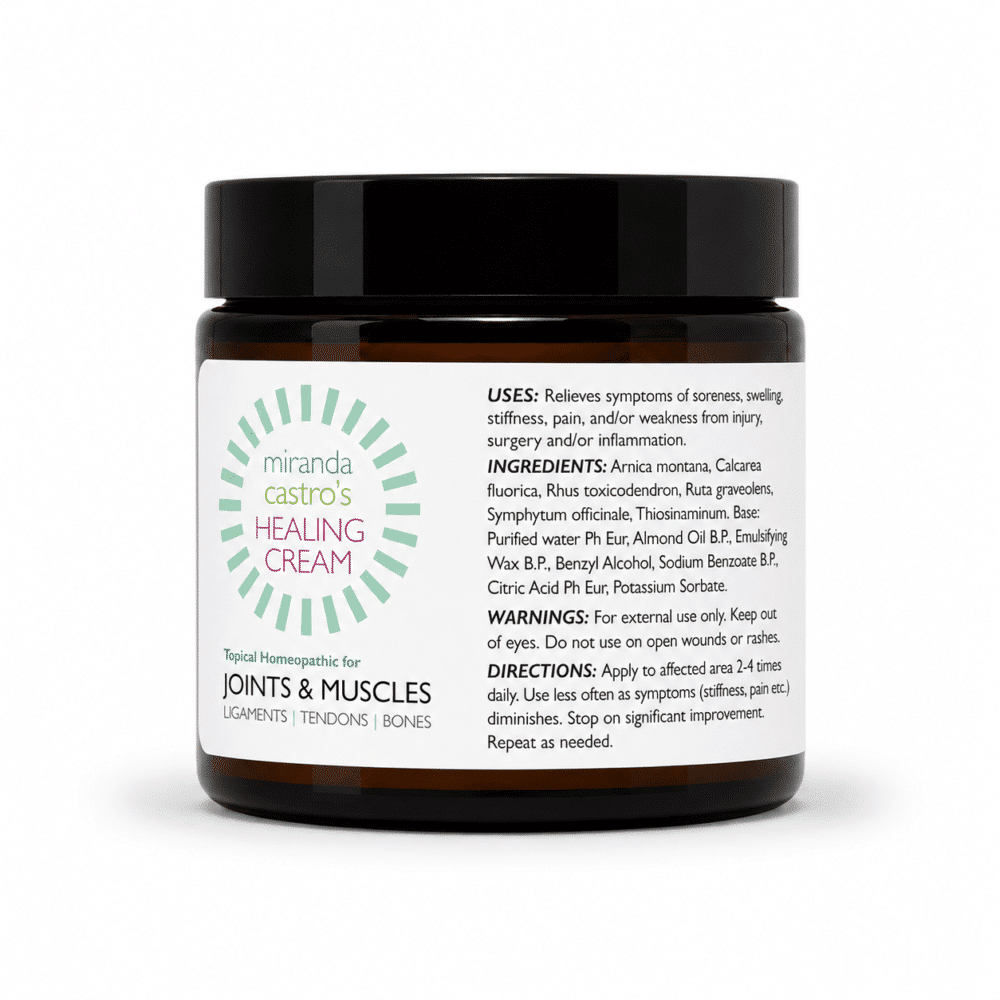
E: That is brilliant, isn’t it? Amazing. Now, Miranda, I quickly just want to chat about your shop. So your website is www.mirandacastro.com and you’ve got a great online shop with your books there and you’ve got kits and you’ve got creams, some that you make yourself and you’ve got creams and cell salts and more from Helios and other pharmacies as well. So for our listeners, this is going to be on YouTube as well.
M: For the inflammation from arthritis or injury and then for scars, that’s my Scars Cream that I developed for newly delivered mothers with their episiotomies and C-section scars. At first Helios made it, they custom made it for me for many years. And then I tweaked it and found a manufacturer and it’s now, it’s really good.
E: You must be somebody that likes to work with your hands before we, because before we started recording, you showed me a plant that you have outside that you said you can use it to, as like a conditioner for your hair. So you obviously are.
M: Yes, I forget which ginger is, which Latin name, but I do. I love to garden. It’s one of my favorite things.
E: Amazing. So Miranda, this has been like a dream come true for me chatting with you today. But before we finish off, tell me about your favorite three remedies, because I haven’t done this in ages, tell me.
M: Bellis perennis, because Arnica doesn’t always work. It’s a really good specific remedy for bruises and injuries, but doesn’t always work. And it hardly ever works for me, whatever injury I’ve got. I’m never okay after I injure myself, never. Okay. You know, that’s the keynote for Arnica. When I am injured I want people to comfort me. Someone who needs Arnica says, don’t touch me. I’ll be fine. They will say I’m okay with blood pouring from the head.
E: Yeah. I mean, Bellis perennis is better than Arnica for certain injuries and situations.
M: People who need Bellis have deep aching, deep bruising after an injury. Arnica doesn’t work. And there are sore, bruised pains, especially the abdomen or the pelvic organs. It’s brilliant after childbirth where those, that whole area is battered.
E: We were told it’s the remedy for the boobs and the balls.
M: I like that. I was going to say breasts and testicles. Oh, we can go with boobs and balls! And Bellis is for lumps and bumps remaining after injury, especially after an injury to the breast.
M: Bellis for the groin ligament, you know, when later in pregnancy, like the third trimester where the baby, especially after the baby’s head engages and walking becomes really painful, you can get these sudden pains that take, you know, like I don’t think you’ve ever had that. But Bellis perennis is specific for that.
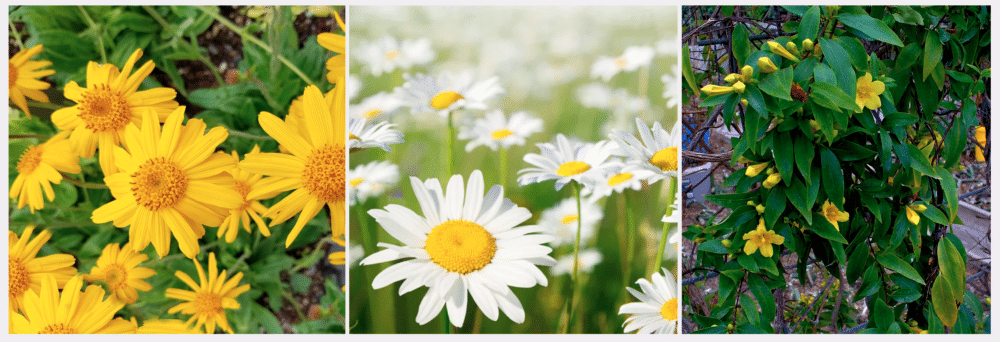
E: Wow I am so glad that you’ve mentioned that. That’s amazing. And they’re both daisies.
M: Yes! Bellis and Arnica are both daisies from the daisy family. Yeah. The little plants at our feet. So I’m all about what happens when a remedy that you think should work doesn’t. Don’t give up. Find another one.
M: Gelsemium is a favorite of mine. It’s been brilliant for COVID. If you need Gelsemium, even if you’re a homeopath, you will never know it because you cannot think. That’s a keynote for someone needing Gelsemium. One time I had a bad flu. I took a load of remedies. Nothing worked. I had a friend visit who’s a homeopath. She took one look at me, asked one question, and put Gelsemium in my mouth. And I was well overnight. Now, I was thirstless. That’s what she asked me. Are you drinking? No, I’m not thirsty. But I couldn’t. And so I noted the gestalt of how I felt. And the next time I had a flu with that constellation of symptoms, I can’t think like that. And I’m not thirsty. And I don’t want to talk. I couldn’t see that my eyelids were heavy. Couldn’t see it.
M: I remember when I had my first ever mastitis, and I was delirious with a fever. And I remember thinking, oh, I’m delirious. That’s Belladonna. So I hear you. I actually, in my delirium, knew that I was delirious and knew to take belladonna.
E: Oh, well done. Well, that’s very clever. Yeah.
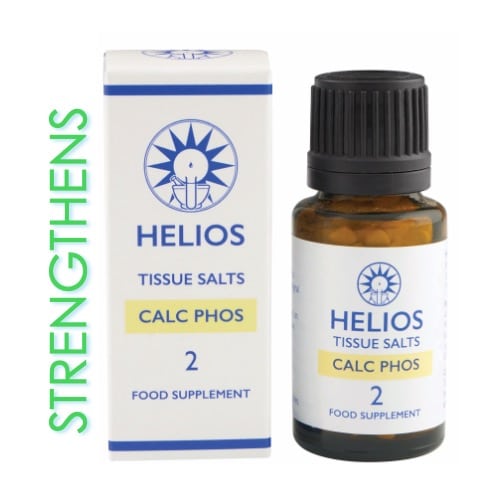
M: I was very lucky. Yeah. The last remedy is Calcarea phosphorica, 6X, because I am a huge fan of the tissue or cell salts. And Calc phos, you could run, you could earn a living from Calc phos 6X, because it’s so brilliant for children of any age during or after a growth spurt, where they just flag, and they’ve got no energy, and they can’t get up. They can’t think. They can’t fall asleep, and the next morning, they can’t wake up. Because people will say, oh, they’re just being teenagers. But no. They need help Calc phos is a brilliant tonic, and they’ll just jump up. They can get up. They need a bit of help. And so Calc phos is brilliant during the growing years.
M: It’s also a specific for osteochondritis (aka Osgood Shlatter’s syndrome). So this is a juvenile arthritis that’s mostly in the knees, where the growth plates, because the bones are growing so fast, the growth plates can’t keep up, and the knees get inflamed. And there’s nothing the doctors can do, nothing that can be done. They have to wait it out, take anti-inflammatories, and it can be a year or two. And if these are athletes, these kids, they are not athletes anymore. It’s really a tragedy. So Calc phos, boom, it’s just a miracle for this. It’s amazing.
E: And actually a lot of, sorry to jump in there, but a lot of the younger kiddies, they will wake up at night time, like screaming their heads off, and ask the moms to rub their legs, put heat packs on it, and the moms won’t know what’s going on. And often it’s very recurring. It’ll happen once a month for years. I’ve had clients that have said, my child’s done this for years, where they wake up screaming in the night, and they’re inconsolable, then so much pain, and they have to give them Panadol, which is like a paracetamol for the pain, and they don’t know what to give them. And then you give them Calc phos, and suddenly the pain goes.
M: Yeah, growing pains. It’s pretty common, and some kids suffer with it more than others. It’s like teething. So my main message is, you can do it. If you struggle, take a class. There are lots now. If you’re not sure, or you can’t figure it out, join one of the Facebook groups. I mean, there’s some lively stuff going on now on Facebook. It’s brilliant. Mary Aspinwall’s got a group, Paola Brown. I mean, these are really fabulous places to get support for home prescribing.
M: So that’s my passion, to see homeopathy more widely accepted and loved. And it’s happening. So yay.
E: Miranda, I am sending you the biggest virtual kiss and the warmest hug across the airwaves to you. Thank you so much for your time. I know that our listeners are going to absolutely love this. We will have this on YouTube as well. And yeah, thank you so much for everything that you’ve done all these decades, and you will be my homeopathic goddess in my books forever and ever.
M: Thank you, Eugenie. You can see my little halo and everything. Much love to you.
Extras! My Articles!
These articles mention the remedies/topics discussed in this podcast!

Check out the latest articles or select a category below.