by Miranda Castro, FSHom, RSHom(NA), CCH
Common names: Phosphate of iron; Ferric phosphate
I remember reading an old article of Roger Morrison’s in Homeopathy Today many years ago about acute prescribing. My interest turned to fascination when Roger got to the part about European homeopaths being better prescribers in acute illnesses than American homeopaths because they give Ferrum phosphoricum more easily and more often. Well not me.
I am a British homeopath who gave up on Ferrum phosphoricum after prescribing it in my early years in practice for fevers without any other symptoms (as indicated by countless texts and teachers) and getting no response.
I witnessed some frightening responses in a few patients of fellow homeopaths. Simple fevers that developed into more serious complaints after Ferrum phos. Two of these patients needed hospitalization and one needed heavy, prolonged medical interventions to save their life. I decided to forgo Ferrum phosphoricum – just in case. And I did not include it in my Complete Homeopathy Handbook.
Here’s the problem: Ferrum phosphoricum is a vague little remedy – one with so few indications that it is often prescribed on just one symptom alone: fever. Or occasionally two symptoms – the first stage of an acute illness with a fever. Which is really and truly just one symptom: a common symptom at that, and the worst kind of symptom on which to hang a homeopathic remedy. There are always many remedies indicated for common symptoms, so selecting one will always be hit or miss.
Fever is the body’s first response to infection – it’s the body’s first line of defense against infection. I came to the conclusion that when a fever is brought down, be it with Aspirin or Ferrum phosphoricum, then a more serious condition may develop as a result. This is because the main fever-fighting mechanisms of the body has been suppressed.
If a homeopathic remedy is prescribed on a single, superficial or common symptom and that symptom goes away, an underlying (more serious) condition can surface. This is suppression as homeopaths perceive it. It tends to be a charged principle in homeopathic discussions with some people believing in it and others poo-pooing it. I have observed and tracked suppression in my own practice and those of other homeopaths and patients and have found it thankfully rare.
It always makes me nervous to treat a person with a fever without knowing where that fever is headed, or at the very least having a couple of good symptoms on which to hang a remedy I can be sure of. I have a profound respect for fevers and their ability to collaborate in the healing process in ordinary everyday acute illnesses. They are not bad in and of themselves.
My patients taught me a cool lesson about fevers. In families where there were 3 or 4 children the first child was sometimes the one who had received the most medical treatments including vaccines, antibiotics and medicines to treat each and every fever. These children tended to have more chronic problems and when they got sick their fevers tended to be low grade and last longer. The younger children were the ones with fewer vaccines and no antibiotics because the parents learnt how to use homeopathy for acute complaints. These children tended to have higher fevers that did not last as long. They recovered faster and were often stronger afterwards.
And then one day, I got stuck with a child who had a low grade fever for nearly a week and a dry hacking cough and no other symptoms. None of the remedies we gave worked. I went back to the homeopathic drawing board to see if I missed anything. Well … no other symptoms duh! I prescribed Ferrum phos as an experiment really and it worked like a charm. Like a good homeopathic remedy should do.
I studied Ferrum phosphoricum more carefully this time and what I read led me to wonder if it had been fully understood – as a homeopathic remedy. Whether it had been fully proven. Choudhuri confirms that it has not been fully proven:
“Most of our symptoms are derived from the writings of Schuessler and from stray clinical experiences of homeopathic practitioners…Most of the symptoms are not authentic as they are not the result of a thorough scientific proving.”
I grew up with Schuessler’s Cell Salts and as a homeopathy student I learnt about them separately (from homeopathic remedies) – as a bona fide group of healing remedies in their own right, to be used as a stand alone system, or as a complement to constitutional homeopathic treatment.
I reflected back on Roger Morrison’s article and wondered whether I might have drawn the wrong conclusion all those years ago. Maybe those patients who ended up in the hospital were developing life-threatening diseases anyway, and Ferrum phosphoricum did nothing. Maybe I had given up on this remedy prematurely.
I pulled out my notes on Ferrum phosphoricum and studied dozens of Materia Medica from the classical to the contemporary, the old to the new! They all said virtually the same thing – repeating each other with minor variations through each and every stage and age. Sigh.
There are relatively few symptoms so it identifies as a ‘small’ remedy with a relatively small sphere of action. I synthesized the picture for myself, for my own understanding, also in order to have this remedy more immediately at hand should the occasion arise to use it. Synthesizing involves identifying patterns across systems (mental, emotional and physical) and organs. The bubbles at the top of this article highlight the main keynote (or very important) symptoms.
Typically the fever is around 101 although it can be lower – 99-100, or a bit higher. 101 is considered high now – back in the day we thought of it as a low grade fever.
A “paucity of symptoms” is homeospeak for patients who present with few strong symptoms. Paucity means a dearth or a want – it’s an old ‘timey’ word meaning sparseness or scarcity. Basically there isn’t much to go on. But sometimes it’s a keynote symptom in and of itself. For people who need this remedy. There tend to be no strong ‘modalities’ … the cough isn’t better or worse for anything in particular. Neither is anything else.
If you are a homeopath or are studying homeopathy you ask the standard acute case-taking questions (usually of the parent or caretaker in the case of a child) but no clear answers are forthcoming. The child isn’t hungry (a common symptom with a fever so not helpful), and isn’t very thirsty or very sweaty. But they aren’t super dry or refusing to drink. They have a bit of a cough with no modalities i.e. nothing makes it better or worse. After 5 or 10 minutes all you have is fever.
Don’t get too excited yet as you’ll be in danger of ‘making’ the patient fit the remedy. A common complaint of homeopaths and home prescribers! And don’t give Ferrum phos routinely and hope for the best. You will get better results if you match two or more symptoms.
With people who need Ferrum phos the face tends to be pale or flushed – or it can alternate between the two. The flushing is more pink than red.
Should you give a 6X or 30C or 200C. It really is brilliant to see that gentle little cell salt (in a 6X) do brilliant healing work with someone who is very sick with a cough or a flu – or both. Here’s a hopefully helpful rule of thumb:
The more symptoms that match the higher potency.
If a person is very sick then you can give the remedy in a higher potency
And … the best potency is the one that you have at hand.
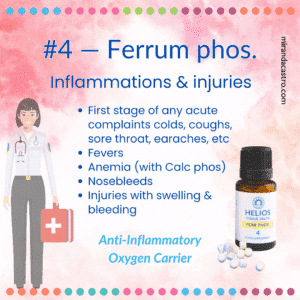
Ferrum phosphoricum is indicated in the first stages of an acute inflammatory infection – such as cold or flu, sore throat, cough, croup, cystitis, otitis media (earache), pneumonia, etc. – but it is a difficult remedy to recognize because there are so few clear indications for its use.
If Aconite doesn’t work for an acute inflammation after one to two hours then Ferrum phosphoricum should be given next if there are still no strong symptoms, if a symptom picture has not yet developed.
You know that the practicing physician does not use Acon. as frequently as some of our other remedies, for the reason that he is seldom called in time. When he reaches the case the Acon. stage of invasion has usually passed. Ferrum phos. follows directly after Acon. and for that reason we often give the former, when if we had seen the case earlier our first prescription would have been Acon.
– Plain Talks by Willard Ide Pierce, MD
▪️ High, dry fever with thirst, without secretions: skin is dry and hot and there is no perspiration.
▪️ Face flushed: typically the face flushes easily (and suddenly) and this flushing alternates with pallor.
▪️ Blood rushes to the part affected (head/eye/throat/chest) and causes feelings of heat and fullness and pulsating/throbbing (like Belladonna) or pressing pains.
▪️ There is no suppuration, no exudation, and no discharge.
▪️ Sudden onset of croup or any cough.
▪️ The cough is short and hacking.
▪️ Coughs up blood or blood-streaked mucus.
▪️ Easy bleeding of bright red blood with any complaint.
= Nosebleeds with any acute illness – especially with a cold. Nosebleed relieves the headache.
= Coughs up blood streaked mucus
▪️ Sudden chill (like Aconite) – especially if chilled while sweating on a hot day (and the sweating stops suddenly)
▪️ A fall or a heavy blow or over-lifting.
▪️ Harvey Farrington (Homeopathy and Homeopathic Prescribing: A Study Course for the Graduate Physician) tells us to give Ferrum phos after an injury with swelling, heat and throbbing but before there is bruising …
“Ferrum phos will relieve more promptly, because of its power to remove congestion. Arnica may be indicated later.”
▪️ Phatak tells us that Ferrum phos controls soreness and bleeding after operations, especially after a tonsillectomy.
▪️ Deafness after a cold (like Pulsatilla).
▪️ The right side tends to be more affected.
▪️ Can feel generally worse for cold, from a draft of cold air except for painful parts (headache, toothache, etc.) which are better for cold compresses.
→ Neither Aconite nor Belladonna are ameliorated by cold applications.
▪️ Can feel generally better for warmth.
→ Unlike Belladonna which is worse for warmth.
▪️ Can be worse for exertion/exercise and/but gentle motion can be helpful (like Pulsatilla).
It is always helpful to compare a remedy with other, similar remedies – to help remember them, and to know what symptoms to look for when differentiating between them.
▪️ Aconite, Ferrum phos and Belladonna can all have acute complaints with fever that comes on suddenly.
→ Aconite has a full, bounding pulse and is anxious and restless.
→ Belladonna is more sudden and violent and the fever is higher (102 and above)
→ Ferrum phos has a quick pulse. Sometimes fever is the only symptom.
▪️ Belladonna and Ferrum phos are both dry.
→ Belladonna is more manic than either Ferrum Phos or Aconite, and is aggravated by touch and jar.
▪️ Both Gelsemium and Ferrum phos have low grade fevers in acute complaints.
→ The acute complaints of Gelsemium start slowly (over days), they have a slow, weak pulse and are drowsy and dull.
▪️ Both Ferrum phos and Gelsemium are likely to be lying down.
→ Gelsemium because they are too weak to stand.
→ Ferrum phos because they feel worse standing.
▪️ Ferrum phos is followed well by Bryonia in coughs and bronchitis etc. especially in children. Sometimes the two remedies can be alternated.
▪️ Give Ferrum phos in the first stage of a cough after Aconite but before Bryonia.
Because Ferrum phosphoricum proved to be incredibly helpful for Covid infections I decided to include it in both my kits (my 30C Complete Kit and my 200C Kit). It was especially helpful with the sudden onset of a low grade fever and respiratory symptoms (cough etc.)
Please use these indications when using it or consult a homeopathic practitioner if you are not sure.
Homeopathy Help Now has a team of homeopaths offering classical homeopathic treatment. They have treated thousands of people with covid infections since 2020 and they also offer a sliding scale.
NM Choudhuri A Study on Materia Medica of Homeopathic Medicines
I have written more about Fevers in Children, their benefits and the homeopathic approach.
© 2020 Miranda Castro … www.mirandacastro.com


Check out the latest articles or select a category below.